
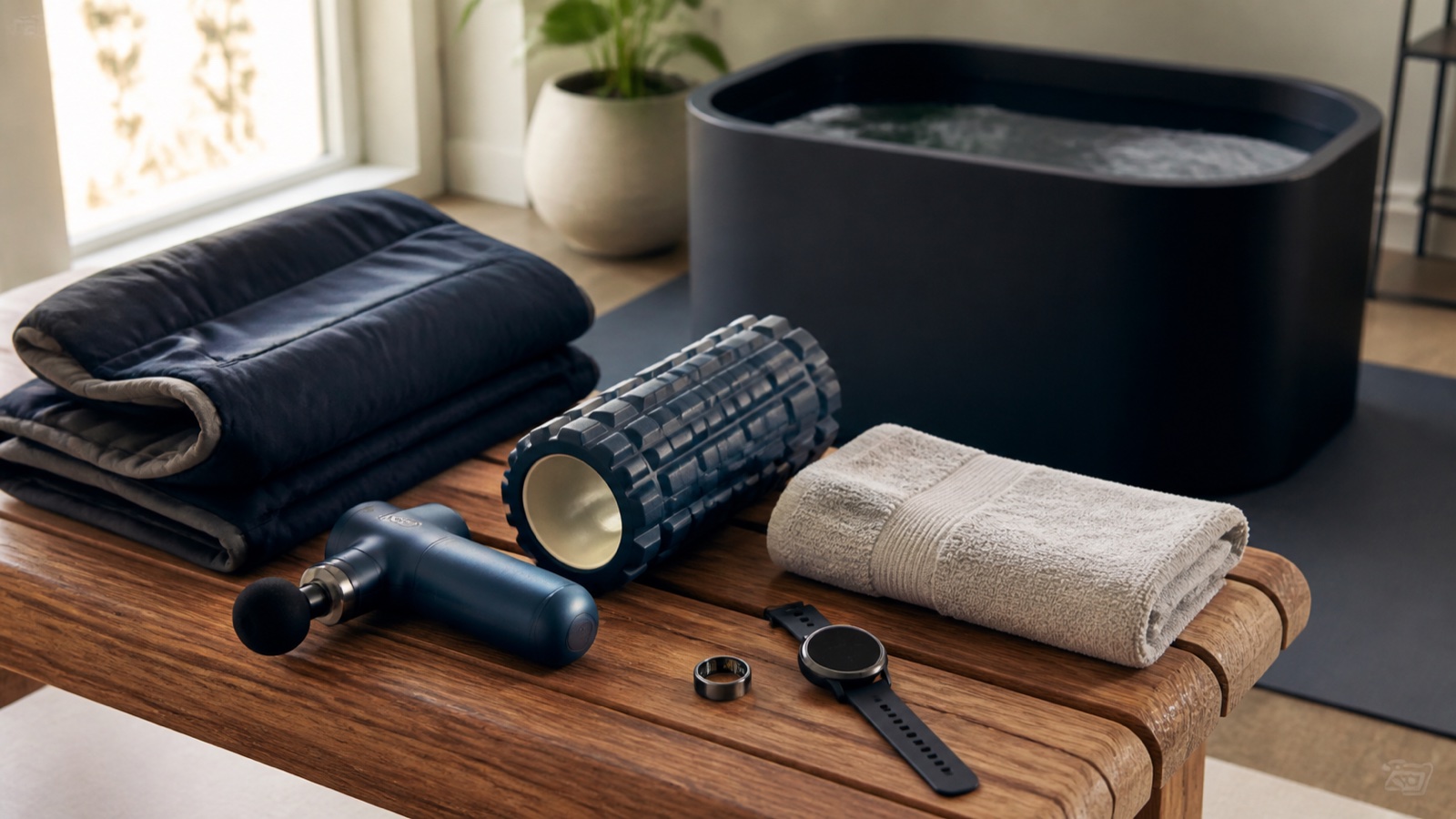
Somewhere between your first fitness tracker and your third recovery gadget, you probably had the same thought: does any of this actually work, or is it just a nicer-looking way to spend money on your body? That’s the question every guide on this site is built around.
This page pulls together everything we’ve covered so far, organized the way you’d actually use it: understanding the data your devices hand you, and choosing the recovery tools worth adding to your routine. No hype, no miracle claims, just the honest version of what each thing does and doesn’t do after 40.
The Quick Answer: Start With the Problem, Not the Product
Recovery technology is most useful when it answers a specific question or makes a routine easier to follow. A wearable can help you notice patterns. A massage gun or compression garment may improve short-term comfort for some people. Cold-water immersion can change how sore or refreshed you feel after certain workouts. None of these tools can diagnose a condition, replace sleep and progressive training, or guarantee faster recovery.
| Your goal | Category to explore | Important limitation |
|---|---|---|
| Understand sleep, HRV, or training patterns | Wearables and sleep trackers | Scores are estimates and are not medical diagnoses. |
| Improve short-term comfort or mobility | Massage guns and compression gear | They do not repair an injury or replace rehabilitation. |
| Manage post-workout soreness or heat | Cold-water immersion | Timing and training goals matter; colder is not automatically better. |
How to Choose Recovery Tech Without Wasting Money
- Name the problem first. Decide whether you are trying to understand sleep, monitor training strain, reduce short-term soreness, manage swelling, or make mobility work easier.
- Choose the least complicated tool that answers the question. More sensors, scores, or attachments do not automatically produce more useful information.
- Count the full cost. Include subscriptions, replacement parts, sizing, cleaning, storage, and the return policy—not just the purchase price.
- Test one change at a time. Use the tool consistently long enough to learn whether it changes a meaningful pattern.
- Stop if it creates anxiety, pain, or unnecessary complexity. A device should support your routine rather than make you feel controlled by a score.
What “After 40” Does—and Does Not—Mean
Forty is not a medical cutoff, and age alone is not a reason to buy recovery equipment. The phrase is useful because many adults in midlife are balancing exercise with long workdays, changing sleep, old injuries, caregiving, or a return to fitness after time away. The fundamentals still matter most: appropriate activity, adequate sleep, nutrition, gradual progression, and medical care when symptoms call for it. Technology is an optional layer on top of those basics.
Choose Your Starting Point
- Understand HRV and readiness scores: Start with the beginner’s HRV guide.
- Compare screenless bands before buying: Read the Hume Band 2.0, Herz P1, and WHOOP 5.0 buying comparison for cost, recovery features and limitations.
- Avoid recurring tracker fees: Check our subscription-free fitness tracker guide for what stays free and how to calculate two-year costs.
- Choose between Oura, WHOOP, and Garmin: Use the wearable comparison.
- Understand your sleep stages: Read the Sleep Trackers guide.
- Find something for soreness and recovery: Begin with the Massage Guns guide.
Wearables & Trackers: Making Sense of the Numbers
A ring or a watch will hand you a number every morning. This section is about knowing what that number actually means before you let it run your day.
HRV Trackers for Beginners: What the Numbers Actually Mean
Heart rate variability sounds clinical, but the idea behind it is simple. Here’s what your tracker is measuring, why there’s no universal “good” number, and how to actually use a readiness score without obsessing over it.
Oura vs WHOOP vs Garmin: Why Your Scores Don’t Match
If you’ve ever checked three devices before your feet hit the floor and gotten three different answers, this is why. Each one is asking a different question about your body, not giving you a wrong answer.
Sleep Trackers for Beginners: What Your Sleep Stages Actually Mean
Light, deep, REM, and a sleep score sitting on top of it all. Here’s what your ring or watch is really doing while you sleep, and how accurate it actually is.
Sleep Number HRV Accuracy
What the bed estimates, what the research validates, and how to interpret your own trend.
Sleep Number HRV Missing or Suddenly Low
A practical troubleshooting checklist for missing readings and unexpected changes.
Product Reviews
Explore product reviews for details, drawbacks, and practical buying considerations.
Manta SOUND 2 Sleep Mask Review
Two weeks of overnight use and occasional naps: blackout, audio, comfort, and weekly charging in my routine.
RENPHO Active RP-GM171 Massage Gun Review
A firsthand review after two years of personal use.
Recovery Tools: What’s Actually Worth Trying
Once you know how to read your own data, the next question is what to actually do about it. These three guides cover the recovery tools people ask about most, minus the marketing.
Cold Plunge vs. Ice Bath: What’s Actually the Difference?
A premium chiller and a basic bag of ice trigger the same physiological response. Here’s what actually matters, temperature, time, and consistency, before you spend real money.
Percussion Massage Guns for Beginners: Do They Actually Help?
That buzzing gym-bag device has decent evidence behind it for short-term soreness, and much thinner evidence for anything beyond that. Here’s the honest picture, plus how to use one without overdoing it.
Compression Gear for Recovery After 40: Does It Actually Work?
Compression socks and sleeves have decades of real medical use behind them, not just a wellness trend. Here’s what they actually do for circulation, swelling, and soreness.
Compression Boots vs. Socks After 40: Which Is Better?
A focused comparison of everyday graduated socks and powered pneumatic boots, including evidence, comfort, safety, cost, and who may find each option useful.
Where to Start
Trying to understand your data? Start with the HRV guide.
Ready to choose a device or recovery tool? Visit the Oura, WHOOP, and Garmin comparison or the Massage Guns guide.
Either way, the goal is the same: understand what you’re using well enough to trust it—or to know when to skip it.
Safety Checks Before You Use a Recovery Tool
- Do not use a wearable score to decide that chest pain, fainting, unusual shortness of breath, persistent palpitations, or another concerning symptom is safe.
- Avoid applying percussion directly over an acute injury, broken skin, a suspected fracture, or an area where sensation is impaired. Ask a clinician when medications or medical conditions increase bruising or bleeding risk.
- Compression must fit correctly. New one-sided swelling, severe pain, color change, numbness, or concern for a blood clot needs medical assessment rather than a tighter garment.
- Cold exposure can trigger a rapid cardiovascular and breathing response. People with cardiovascular disease, circulation problems, impaired sensation, or other relevant conditions should obtain individualized guidance before intentional cold immersion.
What the Evidence Supports So Far
The evidence is useful but not uniform. A systematic review of massage-gun studies found possible short-term benefits for flexibility, range of motion, and some recovery outcomes, while also noting a small evidence base and meaningful risk of bias. Compression-garment meta-analyses report small or context-dependent recovery benefits, but do not support treating compression as a universal performance enhancer. Cold-water immersion may improve perceived recovery in some settings, yet repeated use immediately after resistance training may work against certain long-term strength adaptations. That is why Avrontis treats these products as tools with tradeoffs—not requirements.
Sources and Evidence Notes
- Systematic review of massage guns and performance or recovery outcomes
- Meta-analysis of compression garments and exercise recovery
- Updated review of compression garments and running performance
- Meta-analysis of cold-water immersion and resistance-training strength gains
It’s never too late to build a recovery routine that actually makes sense for your body.