
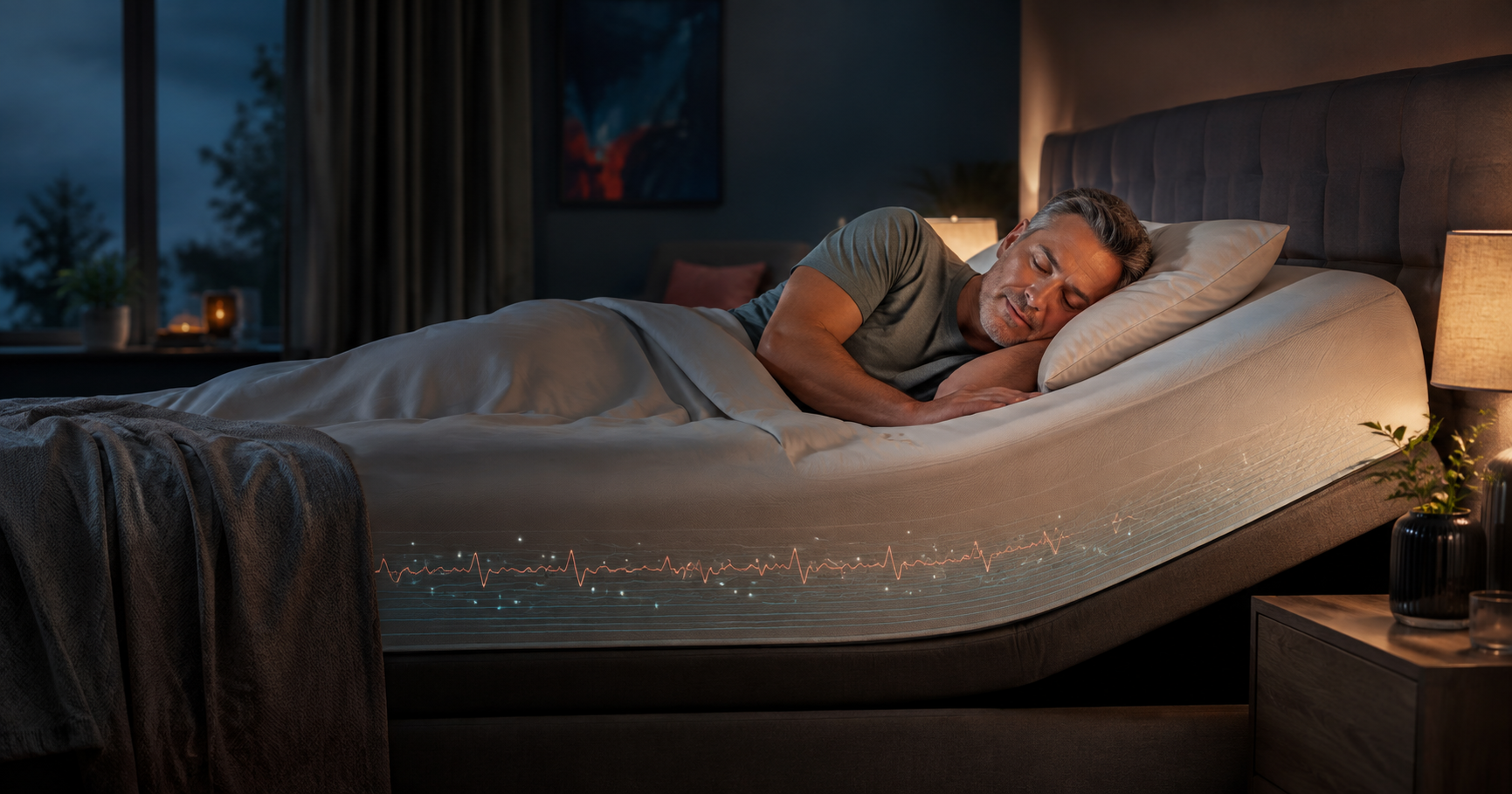
If you own a Sleep Number smart bed, you may have noticed a heart rate variability—or HRV—reading in the Sleep Number app. It can be useful, but it is easy to give one night’s number more meaning than it deserves.
The short answer: Sleep Number provides a convenient estimate of overnight HRV without a watch, ring, or chest strap. It is best used to follow your own trend over several weeks—not as a diagnosis or as a number to compare directly with another device.
What is HRV on a Sleep Number bed?
Heart rate variability measures the small changes in time between consecutive heartbeats. Those intervals are measured in milliseconds. HRV is different from heart rate: heart rate counts beats per minute, while HRV describes how much the spacing between those beats changes.
Part of that variation reflects activity in the autonomic nervous system, which helps regulate recovery, stress, breathing, digestion, and other automatic functions.
- A higher-than-usual HRV can accompany better recovery or lower physiological stress.
- A lower-than-usual HRV can accompany fatigue, illness, emotional stress, alcohol use, inadequate sleep, or demanding exercise.
That does not mean higher is always better. Age, genetics, health, fitness, medications, sleep stage, and the method used to calculate HRV can all affect the result. Your personal baseline is usually more useful than someone else’s number.
How does Sleep Number measure HRV?
Sleep Number says its smart beds collect biosignals through a full-body sensor. The bed detects subtle pressure changes created by movement, breathing, and the mechanical forces associated with each heartbeat. This general method is called ballistocardiography.
The bed then uses signal processing and software to turn that contact-free signal into nightly estimates. Sleep Number reports HRV using SDNN, or the standard deviation of normal-to-normal heartbeat intervals.
This technical detail matters. Many consumer wearables emphasize a different calculation called RMSSD. Devices may also use different sensors, recording periods, filters, and algorithms. A Sleep Number HRV value therefore should not be expected to match an Apple Watch, Garmin, Oura Ring, WHOOP, or chest strap exactly.
How accurate is Sleep Number HRV?
The most defensible answer is: promising for personal trend tracking, but not sufficiently validated to treat the displayed HRV value as a clinical measurement.
A peer-reviewed study compared a Sleep Number smart bed with laboratory polysomnography, the standard clinical sleep test. It included 45 adults ages 22 to 64. Average overnight heart rate from the bed correlated strongly with polysomnography (r = 0.94), as did average breathing rate (r = 0.96). Epoch-by-epoch correlations were lower but still substantial: 0.81 for heart rate and 0.71 for breathing rate. All of the study’s authors worked for Sleep Number, so that relationship matters when weighing the findings.
Those findings support the bed’s ability to collect useful cardiorespiratory signals without a wearable. However, the study did not directly validate the HRV value displayed in the app against electrocardiogram-derived HRV. It also involved one laboratory night, and the researchers were affiliated with Sleep Number Labs and disclosed intellectual-property interests.
A practical accuracy verdict
Sleep Number HRV is reasonably suited to:
- Following your personal baseline
- Noticing a sustained change across several nights
- Comparing similar nights measured by the same bed
- Exploring relationships with sleep, stress, exercise, illness, or alcohol
It is not suited to:
- Diagnosing a medical condition or abnormal rhythm
- Replacing an ECG or medical sleep study
- Making an important decision from one unusual night
- Comparing its raw value directly with a different brand’s device
Why might a reading be missing or unusual?
Sleep Number identifies several situations that can prevent the system from collecting enough high-quality signal:
If your value is missing or suddenly lower than usual, use our Sleep Number HRV troubleshooting checklist to check the sleep session, app, connection and recent recovery factors.
- A short sleep session
- Excessive movement
- Sleeping partly outside the sensor’s effective area
- Sensor interference
Pets, another person, frequent position changes, or spending awake time in bed may also complicate contact-free sleep estimates. If one result looks strange, examine the nights around it before drawing a conclusion.
Does HRV affect your SleepIQ score?
Sleep Number’s current support pages are not completely consistent on this question. Its dedicated HRV guide says HRV is separate from SleepIQ scoring. Its SleepIQ score explanation says biosignals, including HRV, may affect the score when they differ from your personal average.
Because the company’s descriptions differ—and scoring formulas can change—it is safest to view HRV as its own recovery trend rather than trying to reverse-engineer your SleepIQ score.
What is a good Sleep Number HRV?
There is no universal “good” HRV. A more useful process is to build a personal baseline:
- Collect readings for at least two to four weeks.
- Compare measurements from the same device.
- Focus on weekly and monthly patterns.
- Note major influences such as alcohol, illness, travel, strenuous exercise, and poor sleep.
- Compare the data with how rested and capable you actually feel.
If your HRV normally stays within a fairly consistent range and remains noticeably lower for several nights, that change may be worth examining. A single low value following a hard workout or restless night is usually less informative.
How to use the data without obsessing over it
Instead of asking, “Is my HRV high enough?” ask:
- Is it close to my usual range?
- Is this a one-night change or a sustained trend?
- Did my sleep, training, stress, health, or alcohol intake change?
- Does the trend agree with how recovered I feel?
Consumer health technology works best as a pattern-recognition tool. If the data helps you improve sleep consistency or recognize when recovery is lagging, it is useful. If checking the number creates anxiety or makes you distrust how you feel, checking it less often may be healthier.
Sleep Number versus a wearable HRV tracker
Sleep Number’s main advantage is convenience: you receive an overnight estimate without charging or wearing another device. A wearable may be more appropriate if you want daytime activity data, exercise tracking, portable measurements while traveling, or a broader training-readiness system.
For a plain-English explanation of tracker data, read our guide to HRV trackers. To compare devices before buying, see our fitness trackers without a subscription buying guide.
Get practical sleep and recovery updates: Our free email updates cover wearable features, useful research and buying decisions without hype. Unsubscribe at any time.
1 thought on “Sleep Number HRV Accuracy: What Your Reading Actually Means”