
Last reviewed: September 3, 2026
If your legs feel heavy after a workout, a long shift, or a day spent mostly on your feet, both compression socks and pneumatic compression boots can sound appealing. But they solve different problems—and the expensive option is not automatically the better one.
This guide compares how each option works, what the research actually supports, what each feels like to use, and where your money is most likely to make a noticeable difference.
How this comparison was prepared: Avrontis has not personally tested these products. This article is based on peer-reviewed research, clinical guidance, manufacturer specifications, pricing, warranty information, and practical ownership considerations. Product specifications, prices, and availability can change.
Quick answer: Compression socks are the sensible first purchase for travel, long workdays, mild everyday leg heaviness, and budget-conscious support. Pneumatic compression boots make more sense for people who train frequently, enjoy a dedicated 20–30 minute recovery ritual, and will actually use a larger, more expensive device. Neither replaces medical care or the basics: sleep, appropriate training, hydration, nutrition, and regular movement.
Boots vs. socks at a glance
| Question | Compression socks | Pneumatic compression boots |
|---|---|---|
| How they work | Continuous graduated pressure, usually strongest at the ankle | Air chambers inflate and release in a sequence around the legs |
| Best fit | Work, travel, daily wear, mild swelling or heaviness | Post-training relaxation and short, dedicated recovery sessions |
| Typical use | Several waking hours, depending on fit and purpose | Often 20–30 minutes per session; follow the device instructions |
| Convenience | Highly portable and worn while moving | Usually used while seated or lying down |
| Cost | Usually the lower-cost option | Often several hundred dollars |
| Main drawback | Can be difficult to put on and uncomfortable if poorly fitted | Cost, storage, charging or tubing, and limited mobility during use |
| Evidence for exercise recovery | Mixed; soreness may improve more consistently than performance | Small or uncertain average benefits; soreness may improve for some users |
Affiliate disclosure: This article contains Amazon affiliate links. If you buy through them, Avrontis may earn a commission at no additional cost to you. Affiliate relationships do not determine the conclusions in this guide.
How compression socks work
Graduated compression socks provide steady pressure around the lower leg. The pressure is normally greatest near the ankle and gradually decreases higher up the calf. This can limit fluid buildup and help blood return from the legs.
That makes socks especially practical when the challenge lasts for hours: a flight, a desk day, retail or hospital work, or another situation involving prolonged sitting or standing. They work while you move, fit in a small bag, and cost far less than a powered system.
The tradeoff is fit. A sock that bunches, rolls, pinches, or is the wrong size can be uncomfortable and may create excessive pressure in the wrong place. Compression is measured in millimeters of mercury (mmHg). Do not assume that a higher number is better; stronger medical-grade compression should be selected with professional guidance.
How pneumatic compression boots work
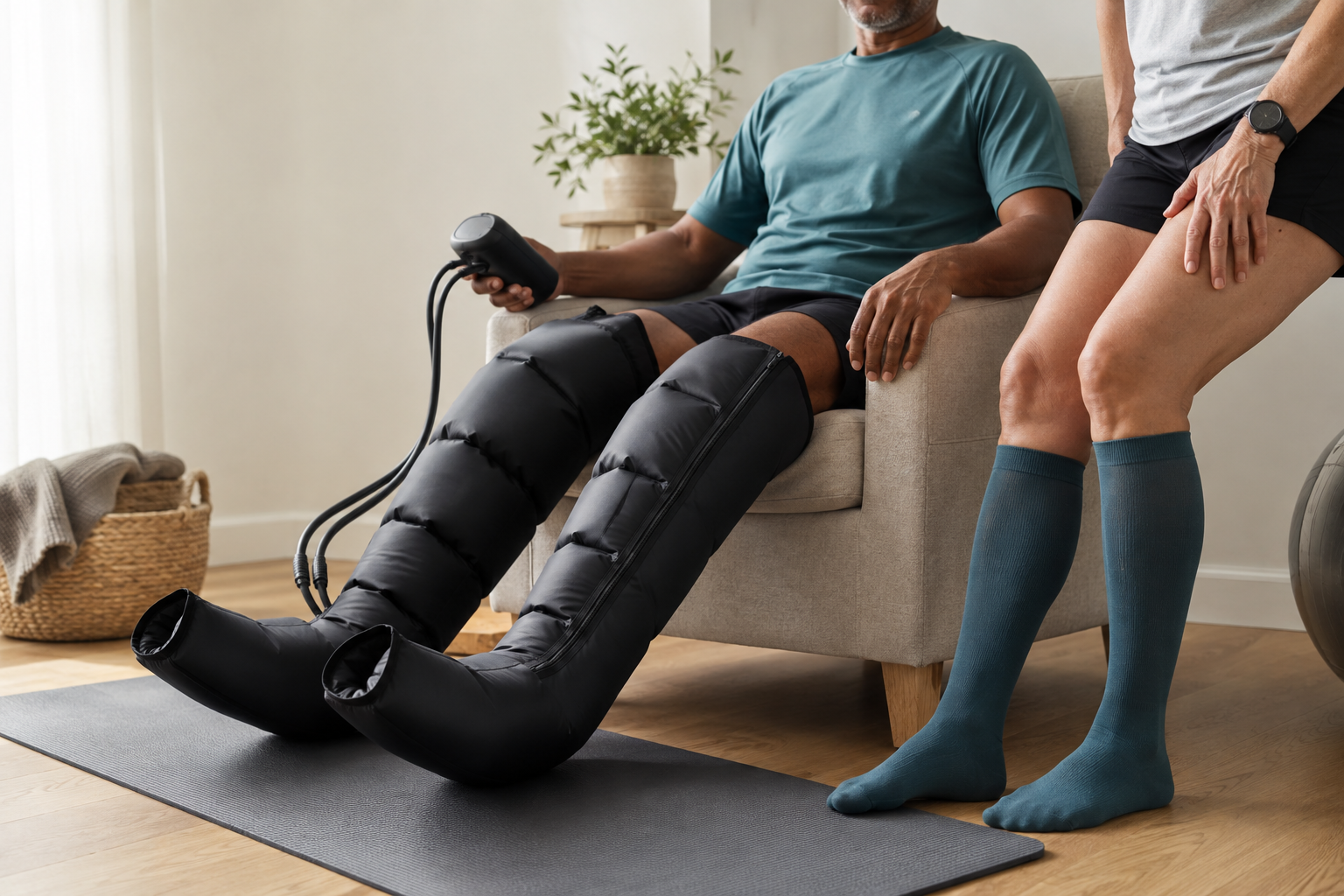
Pneumatic boots wrap around most or all of the legs. A pump fills overlapping air chambers in a repeating sequence, creating a moving squeeze-and-release sensation. Consumer models usually let you adjust pressure and session length. For example, Therabody lists four overlapping chambers and adjustable 25–100 mmHg pressure for its JetBoots Prime, while specific features vary by model.
The experience is more active and noticeable than wearing socks. Many people value the ritual: sit down, elevate the legs, and relax while the system cycles. But that also means boots require dedicated time. They are not something you wear while walking around the office or airport.
What the research says about recovery
The evidence is useful, but less dramatic than many product pages suggest.
- A 2024 systematic review and meta-analysis of lower-limb intermittent pneumatic compression found generally trivial-to-small effects on muscular function, with variable effects on soreness and muscle-damage markers. The authors also noted small samples and limited evidence.
- A 2022 systematic review found that compression garments worn during or after training did not clearly improve the recovery of muscle strength.
- A broader 2022 scoping review covering 183 studies found no consistent benefit across cardiovascular, cardiorespiratory, muscle-damage, or swelling outcomes, although perceived soreness and pain may improve.
- Earlier reviews have reported possible benefits for recovery from exercise-induced muscle damage, but the results vary substantially among studies.
The most honest interpretation is that either form of compression may help some people feel less sore or more comfortable, but neither reliably produces a large improvement in performance recovery. A pleasant sensation is still a valid benefit—just do not confuse it with proof of faster tissue repair.
Comfort and wearability after 40
Compression socks
Socks are easier to integrate into normal life, but they can be difficult to pull on—especially if hand strength, hip mobility, or back comfort is limited. Look for clear calf-and-ankle sizing, a nonbinding top band, breathable material, and a return policy. A donning aid can make firmer socks easier to manage.
Compression boots
Boots avoid the struggle of pulling tight fabric over the calf, but the sleeves can be bulky and warm. Wired systems may offer strong value but create more setup. Fully wireless boots are cleaner and easier to travel with, although usually more expensive and heavier on the legs. Check inseam sizing, total weight, battery life, pressure range, return terms, and replacement-part availability before buying.
Which one makes more sense for you?
Choose compression socks first if:
- You want support during long periods of sitting or standing.
- You travel regularly and need something compact.
- Your budget is limited or you are unsure whether you enjoy compression.
- You want a product that works while you continue your day.
Consider pneumatic boots if:
- You train several times per week and want a repeatable post-workout routine.
- You prefer adjustable, sequential pressure over continuous sock compression.
- You can comfortably spend the money after covering higher-impact basics.
- You have space to store the system and will use it consistently.
Avrontis verdict: For most people, well-fitted compression socks are the better first experiment. Boots are a premium convenience and comfort purchase—not a necessary upgrade. If you already know that compression feels good, train often, and will use a 20–30 minute session several times a week, the cost may be easier to justify.
Safety: when to ask a clinician first
Compression is not appropriate for every leg problem. Speak with a qualified healthcare professional before using compression socks or powered boots if you have diagnosed or suspected peripheral artery disease, a current or suspected blood clot, sudden or unexplained swelling, heart or kidney failure, severe neuropathy or reduced sensation, fragile or damaged skin, open wounds, or a skin infection. Also seek guidance after recent surgery or when treating a diagnosed vascular or lymphatic condition.
Stop using compression and get medical advice if you develop pain, numbness, tingling, skin discoloration, skin damage, or worsening swelling. Consumer recovery equipment should not be used to self-treat unexplained one-sided leg swelling, chest pain, or shortness of breath.
A smarter shopping checklist
- Define the job. Daily support and travel point toward socks; dedicated recovery sessions point toward boots.
- Measure carefully. Use the brand’s sizing chart rather than guessing by shoe size alone.
- Start conservatively. More pressure is not automatically more effective or safer.
- Check the return window. Comfort and fit are personal, especially with compression.
- Ignore miracle language. Look for adjustable pressure, durable construction, warranty support, and realistic claims.
Frequently asked questions
Are compression boots better than compression socks?
Not universally. Socks are usually the more practical choice for travel, prolonged sitting or standing, and daytime support. Boots provide adjustable, sequential pressure during a dedicated recovery session. Research does not show that either option consistently produces a large improvement in exercise performance recovery.
Can you use compression boots and socks on the same day?
Some healthy adults may use socks during the day and boots during a separate recovery session, but more compression is not automatically better. Follow each product’s instructions, avoid wearing both at the same time unless directed by a clinician, and ask a healthcare professional first if you have a circulation problem, unexplained swelling, reduced sensation, recent surgery, or another relevant medical condition.
How long should you use compression boots?
Consumer sessions are commonly around 20–30 minutes, but the correct duration depends on the device and the individual. Begin with the manufacturer’s recommended session and a conservative pressure setting. Stop if the boots cause pain, numbness, tingling, skin discoloration, or worsening swelling.
How long can you wear compression socks?
Many compression socks are designed for use during waking hours and are removed before bed. The appropriate duration and compression level depend on why you are wearing them. Follow the product or clinician’s instructions, ensure the socks fit smoothly without rolling or bunching, and remove them if concerning symptoms develop.
Are compression boots worth the cost?
They can be worthwhile if you train frequently, enjoy the sensation, and will use them consistently. For most people trying compression for the first time, properly fitted socks are the more economical starting point. Boots should be viewed as a premium comfort and convenience purchase, not an essential recovery tool.
Related Avrontis guides
- Compression Gear That Works After 40
- Massage Guns for Beginners: Do They Actually Help?
- Recovery Tech for 40+: The Complete Guide
Sources
- 2024 systematic review and meta-analysis of intermittent pneumatic compression in sports recovery
- 2022 systematic review of compression garments and muscle-strength recovery
- 2022 scoping review of compression garments and exercise
- Meta-analysis of compression garments and exercise-induced muscle damage
- Cleveland Clinic: compression sock use and safety
- Therabody JetBoots Prime specifications
Amazon Associates disclosure: Avrontis is a participant in the Amazon Services LLC Associates Program, an affiliate advertising program designed to provide a means for sites to earn advertising fees by advertising and linking to Amazon.com. We may earn a commission from qualifying purchases at no additional cost to you.
This article is for general education and is not medical advice. Ask a qualified healthcare professional about symptoms, diagnoses, or whether compression is appropriate for you.
1 thought on “Compression Boots vs. Socks After 40: Which Is Better?”