
This article contains Amazon affiliate links. If you buy through one, Avrontis may earn a commission at no additional cost to you. Product selections are independent. As an Amazon Associate I earn from qualifying purchases.
How this guide was evaluated: This article reviews research on exercise-recovery compression and does not substitute for an individualized fitting or medical assessment. No manufacturer sponsored or reviewed it. The linked socks are independently selected examples; inclusion does not mean a particular pressure level is appropriate for every reader.
Trying to decide between everyday socks and powered leg sleeves? Read our focused guide: Compression Boots vs. Socks After 40: Which Is Better?
What Compression Actually Does
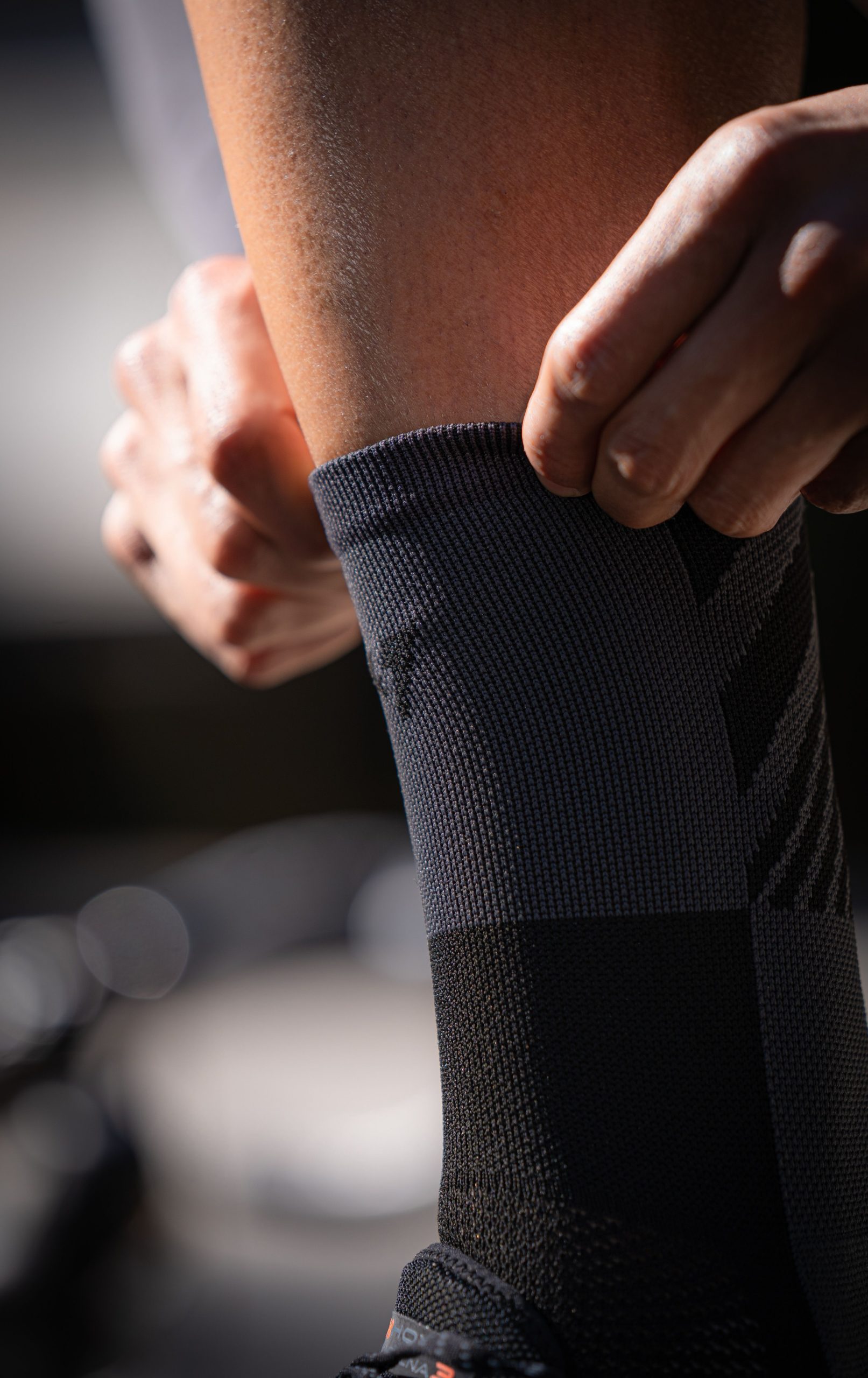
Compression garments apply graduated pressure to your limbs, tightest at the extremities (like your ankle) and gradually looser as it moves up your leg. That pressure gradient is designed to support venous blood flow, helping blood move back up toward your heart more efficiently instead of pooling in your lower legs like rush hour traffic that refuses to merge. This isn’t a wellness-brand invention dressed up in athletic branding. Graduated compression has decades of legitimate medical use for conditions like chronic venous insufficiency and for preventing blood clots after surgery or during long flights. The recovery and athletic versions are, essentially, a lower-pressure adaptation of that same well-established medical principle, just with better marketing photos.What the Evidence Actually Shows for Recovery
Perceived soreness: Compression garments may reduce soreness for some people after exercise, but the size and certainty of the benefit vary. A 2026 review focused on endurance athletes found directionally favorable results, yet judged the evidence very uncertain because studies were small, varied, and difficult to blind.
Strength and power recovery: A 2025 meta-analysis found small improvements in the recovery of strength and power after exercise-induced fatigue. That is more encouraging than saying compression only changes how you feel, but it still does not establish faster tissue healing or a meaningful benefit for every user.
Performance while exercising: Compression clothing should not be expected to make you faster. Recent running meta-analyses found no meaningful improvement in race time or time to exhaustion compared with ordinary clothing.
Pneumatic compression boots: Evidence is mixed. A 2024 review found mainly small or subjective benefits, while a later review found that intermittent pneumatic compression did not reduce soreness compared with control conditions. Their convenience may feel worthwhile to some users, but a higher price does not guarantee better recovery than a properly fitted garment—or than ordinary rest.
Does Being Over 40 Change the Decision?
Age by itself is not a reason to start compression. Some people in midlife spend long hours standing or sitting, notice leg heaviness, or live with a diagnosed venous condition, but those situations are not interchangeable. New, persistent, painful, or one-sided swelling needs medical evaluation rather than self-treatment with a tighter sock.
For exercise recovery, choose compression because it improves your comfort and fits your health situation—not because turning 40 automatically means your circulation needs assistance.
How to Use Compression Gear More Safely
Do not choose pressure by assuming more is better. Retail socks are commonly labeled with ranges such as 15–20 mmHg or 20–30 mmHg, but the right pressure depends on the reason for use, leg measurements, arterial circulation, skin condition, sensation, and medical history. Ask a clinician or trained fitter before using firmer compression if you have swelling, vascular risk, neuropathy, or uncertainty about the correct level.
Fit matters as much as the number. Follow the product’s measurement chart—often including ankle and calf circumference—and make sure the garment lies smoothly without rolling, bunching, digging into the skin, or causing numbness, discoloration, increasing pain, or unusual coldness. Remove it and seek advice if those symptoms occur.
Do not treat overnight wear as a default. Research protocols vary, and a product studied after exercise is not automatically intended for sleep. Follow the specific garment instructions and use overnight compression only when a qualified professional has recommended it for your situation.
Garments and pneumatic boots are not interchangeable. Inflating boots use different pressures and cycles. Follow the device instructions and do not copy a research pressure or session length as a personal prescription.
Who Should Get Medical Guidance First
Speak with a qualified healthcare professional before using compression if you have known or suspected peripheral arterial disease, significant neuropathy or reduced sensation, heart failure, a diagnosed vascular condition, fragile or infected skin, a recent operation, or a history of blood clots. Medical compression is sometimes used as part of treatment for these conditions, but only after the risks, circulation, fit, and pressure have been assessed.
Do not use a recovery sock to self-treat sudden one-sided swelling, warmth, redness, or calf pain. Those symptoms can require prompt evaluation for a blood clot or another medical problem.
Where to Start
If you are generally healthy, have no concerning leg symptoms, and want to test compression only for post-exercise comfort, begin with a correctly measured garment that is easy to remove and whose instructions match your intended use. The Sockwell Women’s Circulator Compression Socks (15–20 mmHg) are one independently selected example—not a universal recommendation.
Try compression during a normal recovery day and notice comfort, skin color, temperature, sensation, and whether soreness or heaviness actually improves. Stop if it causes pain, numbness, discoloration, unusual coldness, or worsening swelling. If you need compression for ongoing swelling or a medical condition, get a professional assessment instead of increasing the pressure yourself.
It pairs well with other recovery basics, too — a percussion massage gun for sore muscles, or a cold plunge or ice bath after a hard session. It’s never too late to give your legs a little extra support. Sometimes the simplest tools are the ones actually backed by decades of real use, not just a good Instagram ad.Sources and Method Notes
- 2026 systematic review of post-exercise compression and endurance recovery
- 2025 meta-analysis of strength and power recovery
- Updated meta-analysis of compression garments and running performance
- 2024 review of intermittent pneumatic compression for sports recovery
- 2025 review including intermittent pneumatic compression after exercise
- International consensus statement on compression risks and contraindications
3 thoughts on “Compression Gear for Recovery After 40: Does It Actually Work?”